EN

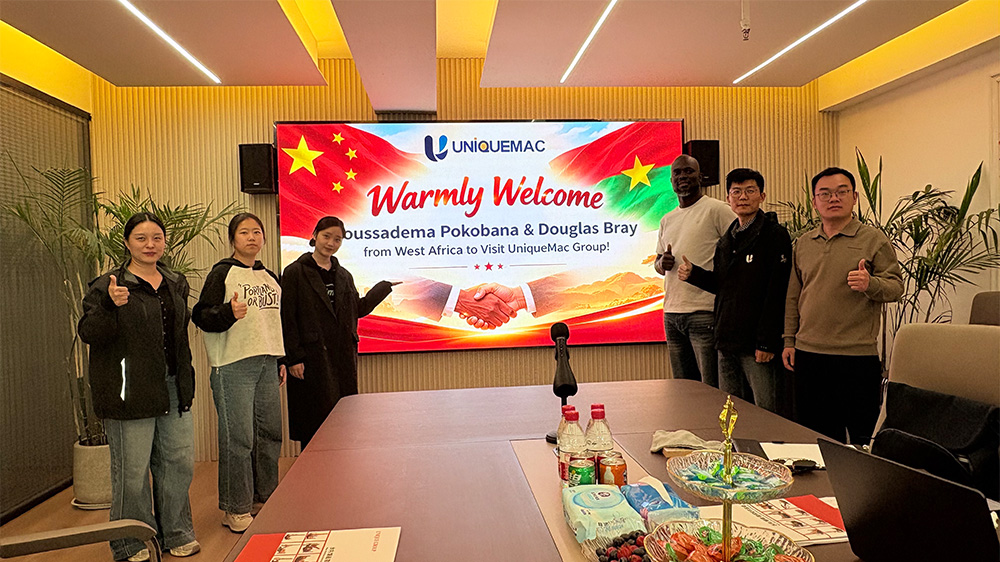
A rig brochure can show a machine. It cannot show how the machine starts, how it moves across a site or how the hydraulics respond when an engineer puts a hand on the control panel. That is why two customers from Burkina Faso travelled to the UNIQUEMAC factory after meeting our team at the Canton Fair, and why the visit ended with them standing at the controls of a 2000m dual-purpose crawler drilling rig instead of reading another specification sheet.
The two visitors first met UNIQUEMAC during the Canton Fair in Guangzhou. The conversation moved quickly from general product questions to a specific one: which machine could handle both water well drilling and core exploration in a market where contractors rarely buy one rig for every job. After the fair closed, the customers did not fly home. They came to the factory.
That decision says a lot about how serious equipment procurement works. Buyers compare structure, engine access, mud system layout, control logic and how a rig behaves under load, and they want to know how it will be maintained where spare part logistics matter as much as performance. A factory visit answers those questions in a way no catalogue can.
Trade fairs create introductions. Factories create confidence. The distance between the two is where most drilling equipment deals are won or lost.
At the Canton Fair, our engineers presented the working principle of the dual-purpose rig, the depth range, the hydraulic layout and the difference between water well drilling and core extraction on the same platform. The customers asked about the mud system, the Cummins engine, the crawler chassis and how the machine would be moved between boreholes. Those questions are hard to answer properly in a hall full of competing booths.
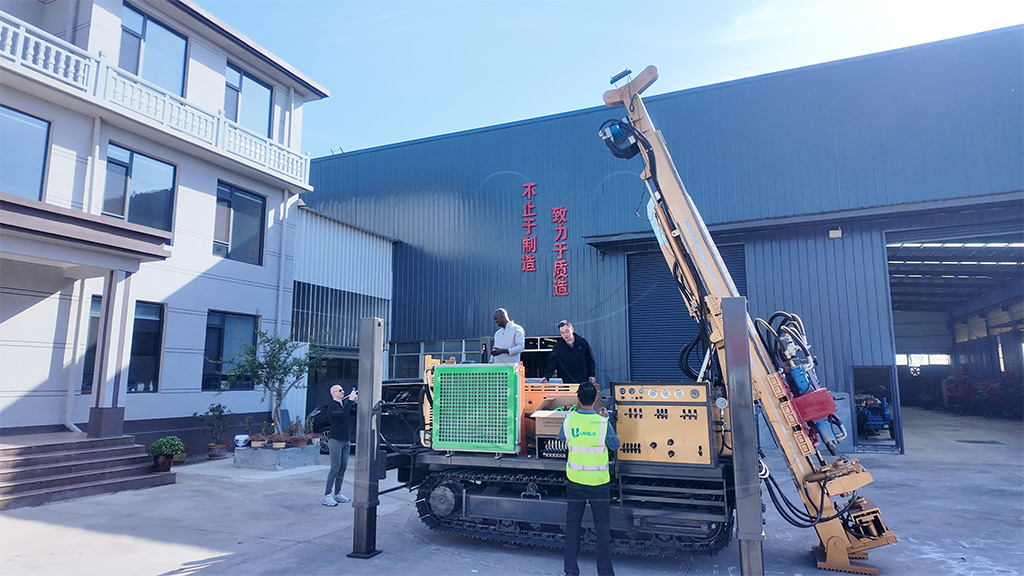
The factory visit changed the quality of the conversation. Instead of discussing a drawing, the customers walked around the machine, checked the welding on the mast, inspected hydraulic piping, looked into the engine compartment and saw how the mud pump is integrated into the layout. They watched the assembly process and asked the test technicians how quality control is handled.
For a buyer in Burkina Faso this goes beyond the technical side. Importing a crawler rig involves a long shipping route, customs clearance and a service relationship that must survive years of operation. Seeing the production floor and confirming that the supplier is a manufacturer rather than a trading intermediary reduces the uncertainty of a first order. By the end of the walkthrough the discussion had moved from what the rig is to what it can do on their projects.
| Item | Configuration |
| Equipment type | 2000m crawler water well and core drilling rig |
| Maximum drilling depth | 2000m |
| Chassis | Crawler chassis |
| Engine | Cummins diesel engine |
| Mud system | Equipped with mud pump |
| Operation | Remote-controlled crawler travel |
| Applications | Water well drilling, geological core exploration |
The demonstration focused on the configuration the customers had come to see. The table below summarises the main parameters discussed during the visit.
One point is worth repeating. The 2000m figure refers to the maximum designed drilling capability. Actual depth depends on the formation, borehole diameter, drill pipe specification and tool configuration. A rig rated for 2000m gives a team headroom for deep targets, but final planning belongs to the project geologist and drilling supervisor.
In water well mode the water well drilling rig works with the mud pump and the corresponding tools to construct boreholes for groundwater development, agricultural irrigation, community water supply and industrial water use. For a contractor in a region where water access is a priority infrastructure topic, a machine that can drill production wells to significant depth is a core business asset.
With the appropriate core barrel and tool string, the same platform recovers rock core samples for mineral exploration, geological survey and formation sampling. Core recovery is a different discipline from water well construction. It requires controlled penetration rates, careful flushing and a tool string that protects the sample. Having one carrier and one power unit that support both disciplines is a practical advantage.
The commercial logic then becomes clear. A contractor who only owns a water well machine will often decline an exploration inquiry because the equipment does not fit. A contractor who only owns a core rig will watch it sit idle between water projects. A dual-purpose unit lets the same team bid on different types of work, keep one spare part inventory and stay productive across more of the year. For customers planning to grow beyond a single project type, that flexibility is usually worth more than a marginal gain in one specialised parameter.
The engine and the mud system were the two items the customers examined most closely, and both were explained in terms of what they deliver on site.
The Cummins diesel engine powers the hydraulic system and the drilling operation. On a large deep hole rig the hydraulic demand is continuous rather than intermittent. Rotation, feed, hoisting, crawler travel and auxiliary functions all draw on the same power unit, often at the same time. The Cummins diesel engine provides the power required for the rig’s hydraulic system and drilling operations. Combined with a properly matched hydraulic system, it supports the demanding requirements of deep drilling work. Engine performance, fuel efficiency and maintenance arrangements are important considerations for contractors operating in remote areas.Cummins also has a broad service presence across Africa, which matters when a machine works far from its delivery port.
The mud pump serves the circulation system. It supplies the pressure and flow needed to move drilling fluid down the hole and back to surface, carrying cuttings out of the borehole. Stable circulation helps maintain borehole stability, and the actual effect depends on the formation, the mud programme and the parameters chosen by the drilling team. A properly sized pump lets the crew adapt the circulation plan to different ground conditions instead of being limited by the machine.
The feature that drew the most attention was the remote-controlled crawler travel system.
Moving a large crawler rig between boreholes is routine but awkward. The operator has to stand beside the machine, judge the ground, watch the track path and coordinate with the crew. On a crowded site, or on ground disturbed by previous drilling, that position is not always convenient or safe. With remote control the operator steps back and drives the rig from a distance, keeping a clear view of the track path and the area around the machine.
For the customers this solves a practical logistics problem. Water programmes need many boreholes across a wide area, and exploration programmes need collars at regular intervals along a grid. Repositioning quickly and safely affects daily productivity more than most specification figures suggest. The remote system also reduces the need for personnel to stand beside the travel controls while the machine moves, which supports safer site organisation. It is a genuine differentiator against a standard large crawler rig.
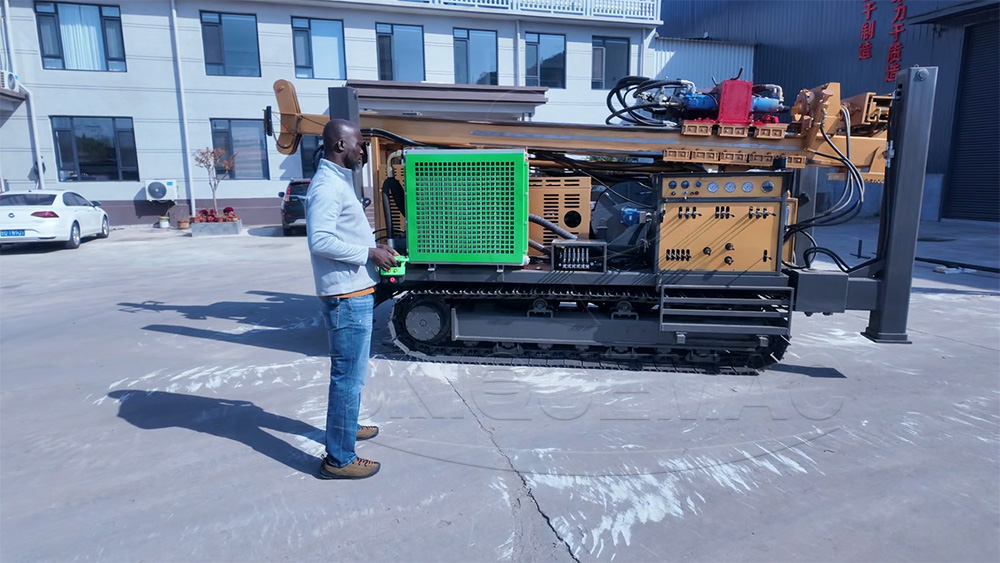
Our engineers began with the basic operating method: control layout, start-up procedure, safety checks before rotation, the main hydraulic valves and how drilling parameters are adjusted. The customers asked about the differences between water well mode and core mode, and how the mud pump is managed when the programme changes.
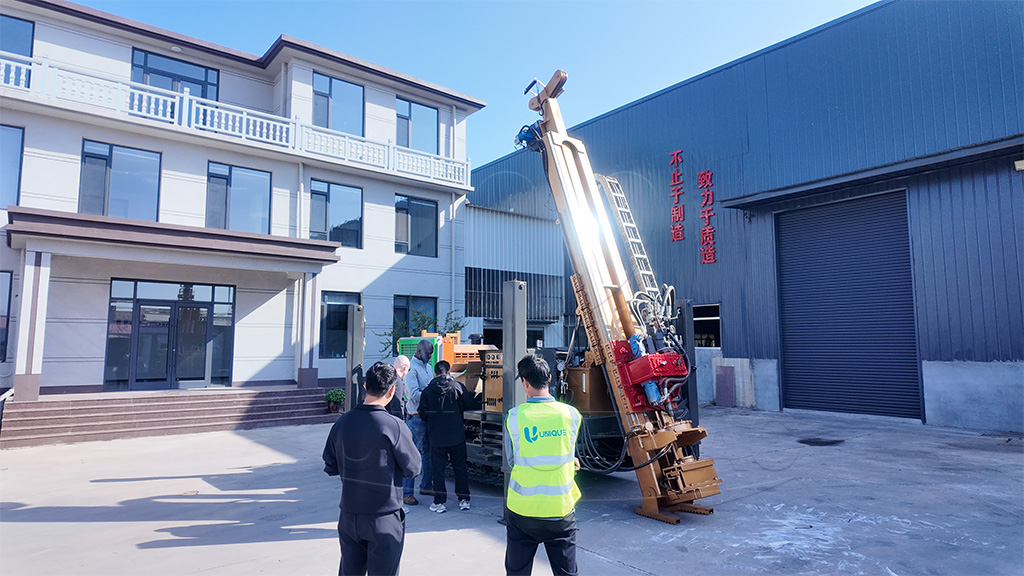
The customers then started the 2000m crawler rig themselves. Starting a machine of this size is a meaningful test. It shows whether the sequence is logical, whether the instruments respond correctly, whether the engine reaches working condition smoothly and whether the hydraulic system builds pressure without delay. Both visitors completed the procedure with the engineer beside them.
Next came the remote control test. The customers took the remote unit, drove the crawler forward and back, adjusted direction and practised positioning the rig as if moving between boreholes. They watched how the tracks responded on factory ground, how the machine held its line and how quickly it could be stopped and repositioned. No video can replicate that.
After the travel test they examined the rotation head, feed system, mast, mud pump connection and maintenance access points, and asked how the machine would be serviced in Burkina Faso and how technical support works after delivery.
By the end of the session the customers had operated the rig, moved it, inspected it and questioned the people who built it. Their feedback was positive and focused on what matters to a working contractor: stable and easy control, a genuinely useful remote travel function, practical maintenance access and a dual-purpose design that fits the mixed project pipeline they are planning. That conclusion carries more weight than a polite comment about a display model.
Choosing drilling equipment starts with understanding the work it needs to perform. In Burkina Faso, drilling contractors and exploration companies may encounter different project requirements, from groundwater development to geological investigation. A dual-purpose drilling rig offers the flexibility to address more than one type of drilling application when equipped with the appropriate tools and systems.
Water Well Drilling and Groundwater Development
Groundwater drilling is an important application for contractors involved in water supply, agricultural irrigation and industrial projects. Different sites may require different borehole depths, diameters and drilling methods depending on local geological conditions and water resource assessments.
The UNIQUEMAC 2000m crawler drilling rig is designed for deep water well drilling applications. Equipped with a Cummins diesel engine and mud pump, it provides a drilling solution for projects requiring suitable power and mud circulation capabilities.
For contractors working on different water well projects, selecting a rig with an appropriate drilling capacity and configuration is essential. The final equipment selection should always consider the target depth, borehole diameter, formation characteristics and required drilling method.
Core Drilling for Mineral Exploration
Core drilling serves a different purpose from conventional water well drilling. It is used to recover underground rock samples, helping geologists examine rock formations and evaluate potential mineral resources.
For exploration contractors in Burkina Faso, having access to suitable core drilling equipment is important when undertaking geological investigation and mineral exploration projects.
With the appropriate core barrel, drill pipes and supporting equipment, the UNIQUEMAC dual-purpose crawler drilling rig can also be configured for core drilling applications. This allows contractors to consider one drilling platform for both water well projects and geological exploration, subject to the required tooling and operating configuration.
One Drilling Rig, More Application Possibilities
For drilling contractors who undertake different types of projects, equipment versatility can be an important investment consideration.
A dual-purpose water well and core drilling rig offers the possibility of expanding business applications without purchasing completely separate drilling platforms for every project type.
By selecting the appropriate drilling tools, drill pipes and supporting systems, contractors can adapt the machine to different drilling requirements. This flexibility may help improve equipment utilization and create opportunities to serve a wider range of customers.
However, water well drilling and core exploration require different operating methods and tooling configurations. Actual equipment suitability depends on the geological conditions, project specifications and the technical configuration selected.
UNIQUEMAC works with customers to understand their drilling requirements and recommend suitable equipment configurations for their intended applications.
 –
UNIQUEMAC focuses on the development, production and export of drilling equipment. The range covers water well drilling rigs, core drilling rigs, DTH drilling rigs and air compressors, with different drilling depths, chassis formats and power configurations available for different project requirements.
The company works with customers in Africa, South America, Southeast Asia, Central Asia and other markets, and the starting point is usually a project description rather than a product number. A contractor in West Africa may need a crawler rig for community wells, an exploration company a wireline coring configuration, a quarry operator a DTH machine with matched compressor capacity. The configuration follows the job.
Support includes factory testing before shipment, technical communication during specification and commissioning, and after-sales assistance for parts and service questions. Factory visits are welcomed, because a customer who has operated a machine knows exactly what will arrive at the port. The working method is simple: understand the drilling programme, propose a configuration that fits it, demonstrate the machine and stay available after delivery.
What is the maximum drilling depth of this rig?
The rig is designed for a maximum drilling depth of 2000m. Actual depth depends on formation conditions, borehole diameter, drill pipe specification and tooling, so final planning should be made with the project geologist.
Can the same rig drill water wells and recover core samples?
Yes. With the right tooling the machine can be configured for water well construction and core exploration. Switching applications requires the correct drill pipes, core barrels and flushing arrangement, and a crew trained for both procedures.
What engine is used on the 2000m crawler rig?
The machine uses a Cummins diesel engine that powers the hydraulic system and the drilling operation. Cummins has a wide service presence in Africa, which helps with parts and maintenance planning.
Why does remote-controlled crawler travel matter?
It lets the operator move the rig between boreholes from a distance with a clear view of the track path. Repositioning becomes faster, and fewer people need to stand beside the travel controls while the machine moves.
Is the rig suitable for all formations in Burkina Faso?
No single configuration is ideal for every formation. Suitability depends on ground conditions, borehole design and tooling. UNIQUEMAC reviews the project profile and recommends a matching configuration.
Looking for a reliable 2000m water well and core drilling rig for your next project?
Contact UNIQUEMAC to discuss your drilling requirements, explore available configurations and arrange a factory visit.
WhatsApp: +86 158 9060 9031
Website: https://www.uniquedrilling-tech.com
Tell us your target drilling depth, borehole diameter, geological conditions and project location. Our team will help you select a suitable drilling rig configuration for your application.